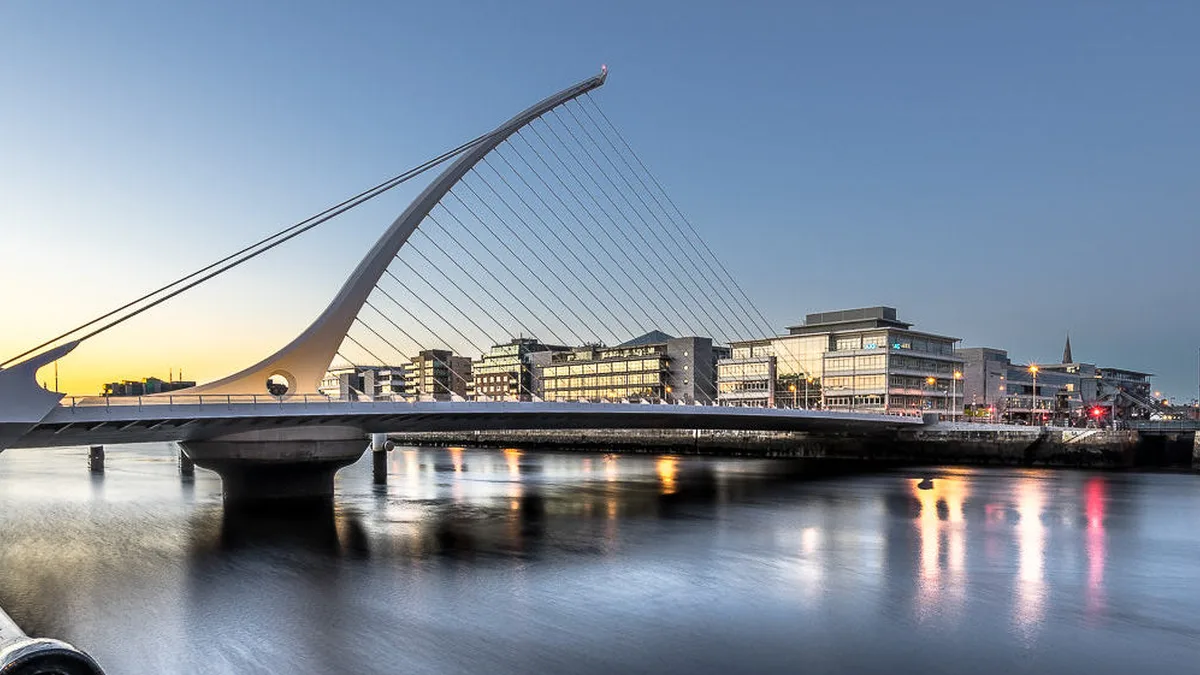
Dublin
| IATA code | DUB |
|---|---|
| Country of origin | Ireland |
| Original use | Civil aviation |
| Terminals | Two (Terminal 1 and Terminal 2) |
| Airlines served | Over 30 |
| Getting there | Bus, taxi, and car |
| Parking | Short-term and long-term options |
Origin and history
Dublin Airport is the primary international airport serving Ireland, located in the town of Collinstown, approximately 10 kilometers north of Dublin city center. Its origins trace back to the early decades of the 20th century, with the site initially developed as a military aerodrome. The decision to develop a major civil airport on the Collinstown site was made by the Irish government in the late 1930s, with construction commencing in 1937. The airport was officially opened for commercial traffic in January 1940, a launch occurring during the Second World War, which significantly limited its initial international connectivity. The original terminal building, known as the Terminal Building or Collinstown House, is a noted example of Irish Art Deco architecture and remains a core part of the airport's infrastructure today. Post-war expansion saw the airport grow steadily to handle increasing passenger numbers, leading to the development of new terminals and runways in subsequent decades.
What it is for
Dublin Airport functions as Ireland's principal aviation gateway, facilitating both passenger travel and cargo transport on a global scale. Its core purpose is to connect Ireland to destinations across Europe, North America, the Middle East, and Africa through a wide range of scheduled, charter, and cargo airlines. The airport serves as the main operational hub for Ireland's national carrier, Aer Lingus, and a significant European base for the low-cost carrier Ryanair. It provides essential infrastructure including two passenger terminals, two runways, and extensive aircraft parking stands to accommodate the operational needs of these and other airlines. Beyond commercial flights, the airport also supports general aviation, state and diplomatic flights, and provides facilities for aircraft maintenance and ground handling services. Furthermore, it plays a critical economic role for the region by supporting thousands of jobs directly and indirectly through its operations and the commercial activities within its campus.
Pros and cons
A primary advantage of Dublin Airport is its extensive network of transatlantic pre-clearance facilities, allowing passengers traveling to the United States to complete immigration, customs, and agriculture inspections before departure, thereby arriving as domestic passengers. The airport's layout, with two main terminals connected by a walkable link, is generally logical, though the separation of airlines between Terminal 1 and Terminal 2 can cause confusion for infrequent travelers. A significant con is the frequent congestion experienced at peak times, particularly during early morning hours, where security queues can extend to over an hour, risking missed flights for those not arriving well in advance. Passengers often regret not accounting for this buffer time, and a common mistake is assuming the queue times will be similar to smaller regional airports. The cost of services within the airport, particularly for food, beverages, and parking, is consistently cited as very high compared to city-center prices, which can add a substantial hidden cost to a journey. While public transport links to the city have improved with dedicated bus services and a forthcoming metro line, the current reliance on road traffic can lead to lengthy and unpredictable transfer times during rush hours.
Who it suits
Dublin Airport best suits travelers whose itineraries originate from or are destined for the greater Dublin region or the eastern half of Ireland, for whom it is the most geographically convenient major airport. It is particularly advantageous for passengers flying to the United States, due to the unique convenience of the pre-clearance facility, which saves considerable time upon U.S. arrival. The airport suits users of its hub carriers, Aer Lingus and Ryanair, who benefit from the deepest network of direct connections and frequent flight schedules offered by these airlines from this base. Business travelers with meetings in Dublin's city center or surrounding business parks find it acceptable due to its proximity, though they must build in significant contingency time for peak-hour road traffic and security processing. It is less suitable for travelers residing in the west or south-west of Ireland, for whom airports like Shannon or Cork may offer a more time-efficient and less congested point of departure, especially for European destinations. The airport also suits transfer passengers connecting between North American and European flights on Aer Lingus or oneworld partners, leveraging the hub structure, though its connectivity options are less extensive than those of major European hub airports.