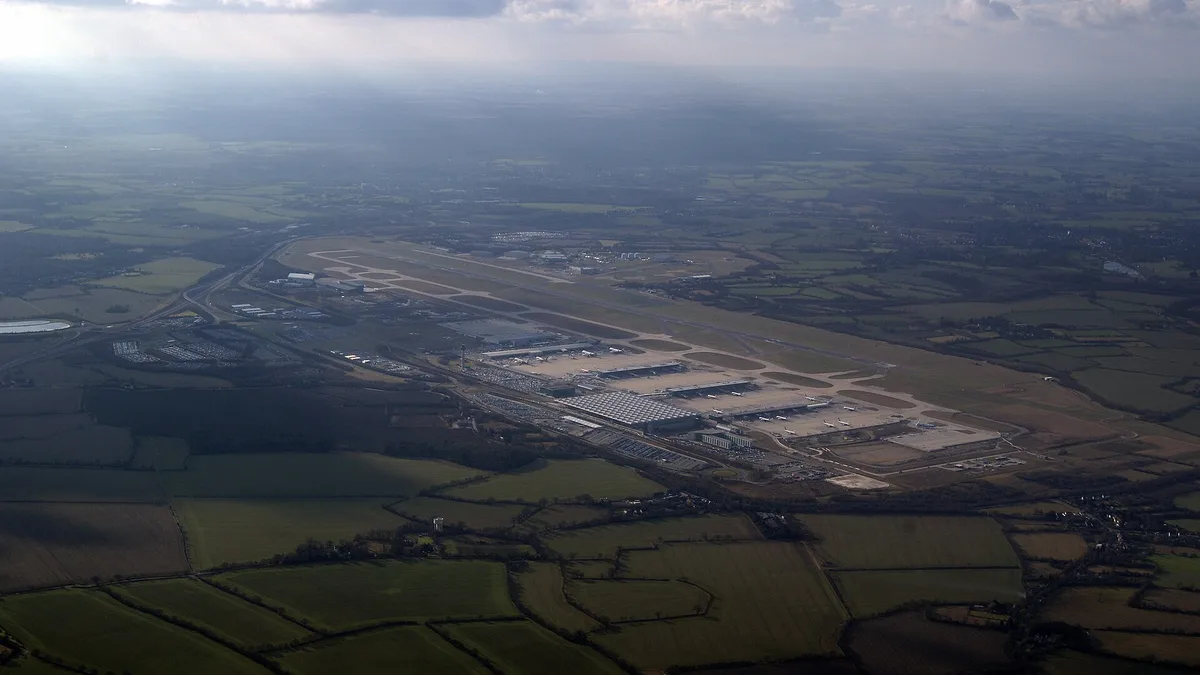
Stansted
| IATA code | STN |
|---|---|
| Official name | London Stansted Airport |
| Country | United Kingdom |
| City served | London |
| Original use | Royal Air Force base |
| First opened | 1943 |
| Owner/Operator | Manchester Airports Group |
| Annual passenger capacity | Approximately 35 million |
Origin and history
Stansted Airport is located in Essex, England, and its origins trace back to the Second World War era. The site was originally developed as a Royal Air Force base, known as Stansted Mountfitchet, in the early 1940s. Following the war, it was used for various purposes including civilian flight training and as a maintenance base. Commercial passenger operations began on a very limited scale in the late 1960s. The airport's modern transformation into a major transport hub commenced in the 1980s following government decisions to expand London's airport capacity. A completely new terminal building, designed by architect Norman Foster, was opened in 1991, establishing the facility's current core infrastructure.
What it is for
Stansted Airport functions primarily as a major base for low-cost and leisure airlines serving the London region. It is a key hub for point-to-point travel across Europe and to a range of international destinations. The airport handles a significant volume of charter holiday flights alongside its scheduled low-cost services. It also supports a considerable amount of cargo operations, being one of the UK's largest freight airports. Furthermore, Stansted serves as a base for private aviation and executive jet travel. The infrastructure is designed for efficient passenger processing for short-haul flights, with a single terminal building and a rapid turnaround philosophy.
Pros and cons
A primary advantage of Stansted is its concentration of low-cost carrier routes, often offering the most direct and budget-friendly flights to many European destinations. The single-terminal layout, despite the airport's size, can simplify navigation compared to multi-terminal complexes. However, a significant con is its distance from central London, with rail and road transfers being notably more expensive and time-consuming than from other London airports. The airport's design and high passenger volume can lead to lengthy walking distances within the terminal and frequent bus journeys to remote aircraft stands. Passengers often regret choosing Stansted when they underestimate the total cost and time of the complete door-to-door journey. A common mistake is booking an early morning flight without confirming the schedule and cost of the necessary ground transport, which can be infrequent and costly at night.
Who it suits
Stansted Airport best suits leisure travelers and visitors whose final destination is in the north or east of London, or in the counties of Essex and Cambridgeshire. It is ideally suited for price-sensitive passengers prioritizing low headline flight fares over total journey cost or convenience to central London. The airport also suits those traveling to specific European regional airports that are only served from Stansted within the London area. It is a practical choice for passengers who can travel light, as its airline mix is dominated by carriers with strict baggage fees. Freight operators and cargo airlines benefit from its dedicated facilities and available capacity. Finally, it suits private flyers utilizing its fixed-base operator services for business or general aviation.
Latest Stansted news
Latest reporting

Emirates Lounge at London Stansted Airport Impresses with Quality and Comfort
The Emirates Lounge at London Stansted Airport offers a peaceful and comfortable experience for business and first class passengers, with a wide...

Free Prosecco at Stansted for Priority Pass Cardholders, Excluding Amex Holders
Priority Pass has launched a new restaurant deal at London Stansted airport, offering £18 credit towards drinks or food at the Bottega Prosecco Bar &...